Racialized and Immigrant Youth in Canada: Are We Really That Inclusive?

Image retrieved from: http://fc02.deviantart.net/fs70/f/2012/268/9/1/canadian_flag_wallpaper_by_magnaen-d1zxsy8.jpg
Oh, Canada...
The effects of our country's violent history of colonialism is still obvious in the population of disadvantaged Aboriginal peoples. As is such, a discourse of eurocentrism still pervades Canadian culture. Nevertheless, Canada holds the international reputation of a country welcoming to people of all nationalities. This assumption could not be any further from the truth. While we do not live in the Deep South of the U.S.A., I can say with certainty that our country is greatly affected by a climate of systemic and intrinsic racism. The racilalized and immigrant youth in Canada, including those born within the country, are at an extreme disadvantage compared to those of European descent, or simply with an appearance of "whiteness". Visible minority youth are prosecuted and imprisoned at rates disproportionate to those of the dominant population (White et al., 73), their families are becoming increasingly economically marginalised (Krahn et al., 4), and they are consistently represented negatively in the media, thus serving as false justification for their oppression.
Boonaa Mohammed's YouTube video titled Green Card gives a first hand perspective of what it is like to live as a visible minority youth in Canada.
Video retrieved from: http://www.youtube.com/watch?v=-Th04ZQCt5A
The prevalence of visible minorities in Canadian provinces:

Image retrieve from: http://www.cic.gc.ca/english/resources/publications/multi-report2010/images/Graph2_EN.gif
Defining the supposed "Other"
-Many visible minorities in Canada are considered outsiders in the communities in which they live, not because their numbers are small, but because they are in a subordinate position (economically, socially, and politically) in comparison to the majority of white Canadians (White et al., 62). This is obviously problematic, for their subordination only works in defining them as "outsiders", and their "outsider" status only increases their subordination.
-Additionally, the status of "outsider" or "Other" is deviant (White et al., 63), meaning the "outsider" in question looks or behaves differently than what is considered to be normal. Because of Canada's history of European colonization, the oldest and most dominant religions in the country are of Judeo-Christian origin. Their influence is pervasive and strong in many different areas, including schooling, law-making, and the media. It is so strong that for many Canadians, seeing someone of visibly different religious beliefs (e.g. a Muslim woman wearing the hijab) causes discomfort, and far too often leads to hateful remarks or violence.
- Islamophobia: Following the attacks on the World Trade Center on September 11, 2001, much hate for Islam has surfaced. People are increasingly fearful of men in turbans and women in hijabs, thus at least unconsciously attributing the actions of 19 radicals to the character of millions of Muslims around the world. This has come to be known as "Islamophobia", and is undoubtedly present in Canada in addition to the United States. I have seen firsthand the racist caricatures, heard the racist jokes, and even seen the uneasiness on the faces of friends and relatives upon passing a Muslim man in the airport.

Image retrieved from: http://www.intuition-online.co.uk/imgs/islam.jpg
"Aside from on America's Most Wanted, we are not wanted here, Because my color and last name still spark fear.
The same kind that can easily become violent
And you can't be protected by studying science,
Because even our nerds aren't good enough for them.
I was born here and I'm screwed."
-Boonaa Mohammed, Green Card
"[Living] Third World in a First World country": Effects of defining the "Other"
- The justification of the subordination of visible minority youth through the media not only serves to keep them defined as "Other", but can also bring them to feel angry and act out their frustrations, sometimes through crime. The elevated rates of imprisonment for minority youth is not a black and white issue- pun intended. There are various social, economic, educational, and political factors, including the biases held by police forces, that work together to create these unfortunate statistics. Below is a link to a study conducted and published by Correctional Services of Canada, depicting the overrepresentation of visible minorities in correctional facilities relative to their population.
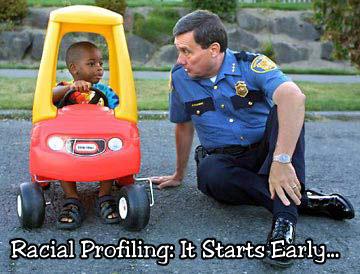
Image retrieved from: http://images.paraorkut.com/img/funnypics/images/r/racial_profiling-12024.jpg
- In the year 2000, unemployment rates for visible minorities in Canada was 7.7% for those between the ages of 25 and 44, and 5.8% for those between the ages of 45 and 64. This can be compared to the rates of unemployment for non-visible minorities of the same age groups, which were 4% and 3.2%, respectively (Doyle et. al 2012). Because the rates of unemployment are noticeably higher for visible minorities, it can be attributed with due certainty to racism, if not overt then systemic and intrinsic. While the age groups sampled cannot be considered visible minority youth, they should be considered the parents of such youth. Unemployment does not only mean poverty for those without jobs, but also for those dependent on them, namely their children.

Image retrieved from: http://this.org/magazine/files/2010/11/10nd-living-wage-600x347.jpg
- When the unemployed men and women of visible minorities finally get work, it is likely to only provide a low income. Human Resources and Skills Development Canada also found that in 2000, "Canadian visible minorities' average employment income was approximately 86% of the general population's average" (Doyle et al. 2012). This does not mean that they are not qualified or educated enough for higher income jobs. On the contrary, those who have immigrated to Canada are often of higher education than most Canadian-born individuals because of recent selective immigration policies (Krahn et al, 4). Obviously, university degrees do not afford immigrants the opportunities that should be expected. In Boonaa Mohammed's video above, the poet describes the personal effects of such alarming statistics:
"Geniuses drive your cabs
And I've had to work twice as hard
For every single thing that I've had,
From sellin' my stash,
Tryin' to make that quick, easy cash.
Dead-end jobs that might leave you...
Dead, on the job."
- Much can be said about white privilege and the exclusion of "Other" in our education systems. The curriculums are racist, focusing only on European history and often painting colonization in a positive light. Boonaa Mohammed describes Canada as a place where visible minority youth "can grow up learning nothing about [them]selves" (Green Card), and this couldn't be more true. I, a white, Canadian-born 20 year-old, cannot recall ever having learned about Islam, Southeast Asia, India, or Indigenous culture in my high school history classes.
- Conversely, national survey data from the 2000 Youth in Transition Survey show that the educational aspirations of 15-year old visible minority immigrant Canadians are much higher than those of native-born Canadians (Krahn et al., 1). There are many possible explanations for this data. One could be the drive to lift one's family up from poverty. More than 30% of immigrant youth come from families whose incomes fall below the national poverty line (Krahn et al., 4). As is such, this explanation carries some weight, but these youth could also simply be feeling pressure from their highly educated parents to follow in their footsteps. Moreover, there are many ethnic differences in the value put on education. A longitudinal study conducted in the United States concerning educational aspirations of ethnic groups found that Asians were the most likely to maintain their aspirations after grade 10, while Blacks were the least likely (Krahn et al., 5).

Image retrieved from: http://www.yorku.ca/web/about_yorku/images/grads.jpg
Some final words
- While some visible minority youth are evidently fighting their oppression in gaining superior education, much more needs to be done on Canada's part to stop the systemic racism responsible for disparities in rates of incarceration, unemployment, and income. The native-born Canadians of European descent need to recognize their agency in the subordination of visible minority Canadians and recent immigrants. In acknowledging our white privilege, we can take further steps in the direction of the reputation we hold internationally, that is a country of equal opportunity and acceptance of all nationalities.
* * *
Works Cited
Doyle, Robyn and Usha George. "Archived- Socioeconomic Integration of Visible Minorities and Aboriginal People in Toronto." Human Resources and Skills Development Canada. N.p., n.d. Web. 11 Oct. 2012. <http://www.hrsdc.gc.ca/eng/labour/equality/racism/racism_free_init/george-doyle.shtml>.
Krahn, Harvey, and Alison Taylor. "Resilient Teenagers: Explaining the High Educational Aspirations of Visible Minority Immigrant Youth in Canada." PCERII Working Paper Series 1 (2005): 1-27. Print.
N.A. "The Nation's Broad Definition of Islamophobia." Reason.com. N.p., n.d. Web. 9 Oct 2012. <http://reason.com/archives/2012/06/24/the-nations-broad-definition-of-isamomph>.
Krahn, Harvey, and Alison Taylor. "Resilient Teenagers: Explaining the High Educational Aspirations of Visible Minority Immigrant Youth in Canada." PCERII Working Paper Series 1 (2005): 1-27. Print.
N.A. "The Nation's Broad Definition of Islamophobia." Reason.com. N.p., n.d. Web. 9 Oct 2012. <http://reason.com/archives/2012/06/24/the-nations-broad-definition-of-isamomph>.
White, Rob, Johanna Wyn, and Patrizia Albanese. Youth and Society: Exploring the Social Dynamics of Youth Experience. Canadian Edition. Don Mills: Oxford Univeristy Press, 2011. Print.