A Review of Chapters 1 Through 3 in Deborah Tolman's Dilemmas of Desire

Image retrieved from: http://photo.goodreads.com/books/1172858150l/225044.jpg
Some Key Concepts
- Tolman found that many girls, typically of high school age, are at a loss in how to deal with their natural feelings of sexual desire.
- There is an underlying social discourse saying that girls do not and should not feel sexual desire. That it is not "natural." Because of this, girls who do acknowledge their feelings of desire often must deal with unfortunate consequences. E.g. slut shaming.
- Controlling female sexuality can be seen as a key component in the oppression of women (16).
- "Silent bodies" or not feeling desire puts girls at risk and "vulnerable to the power of others' feelings as well as what others [they do and do] not feel" (21).
"Since rape is predicated on a woman not wanting a sexual experience, if [she] never has feelings of want or desire, how can she know if she has been raped?" (65)
- The dilemma of a girl's sexual feelings over her safety is a SOCIETAL problem, not an individual problem. Many girls see it as just the opposite:
"[They had] acute and astute awareness of the dangers associated with with their sexuality, the denigration of their sexual feelings, and their expectations about boys' sexuality led most of them to consider the source of danger to be their own sexuality" (47).
- The common sexual education curriculum, that which instils a fear of sex, is not functional.
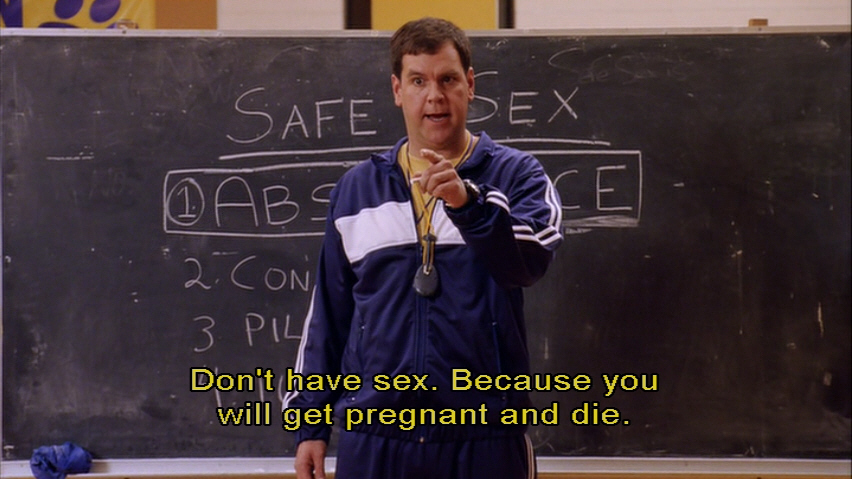
Image retrieved from: http://thethoughtexperiment.files.wordpress.com/2010/05/mg_by_ekitty_020.jpg
Characteristics contributing to the novel's strong relation to contemporary society:
- Tolman's insertion of her subjects' personal anecdotes allow for a very intimate understanding of how many teenage girls experience their sexuality.
- Tolman chooses to include certain narratives which highlight the fact that some girls are consciously aware of their lack of sexual agency and the fact that this is a result of societal pressures. For example, Kim's story in Chapter 3 describes a lack of enjoyment of sexual activities because she feels as if "she is being treated as the object of someone else's desire [...] as if who she is does not matter" ( 73).
- The novel successfully identifies our culture's problem of slut shaming and its many grave consequences. Such consequences do not only involve those who are shamed, but also those who witness it and their resulting lack of sexual agency for fear of being shamed themselves. More information on slut shaming can be found in the video below, taken by a very precocious 13 year-old girl who is evidently aware of its dangers.
Video retrieved from: http://www.youtube.com/watch?v=SXH2K7OC37s
- Tolman's study of suburban girls in addition to the commonly studied urban girls weakens the myth of the latter's excessive sexual activity and the former's lack of it.
- Even with the novel having been published a decade ago, one can draw many parallels with Tolman's discussion on moral panic and the ongoing controversy of women's reproductive rights in the United States, most recently Todd Akin's ridiculous theory on "legitimate rape".
 Image retrieved from:

A single critique:
- Certain parts of chapters 1 through 3 do not pertain to the aforementioned anecdotes and were rather dry and data-heavy. One would assume that the novel's intended audience is the population of young girls who are affected by their own dilemmas of desire. As is such, it could be argued that Tolman could have made these non-anecdotal sections less laden with jargon and easier for her intended audience to grasp.
* * *
Works Cited
Tolman, Deborah. Dilemmas of Desire: Teenage Girls Talk about Sexuality. Cambridge: Harvard University Press, 2002. Print.


No comments:
Post a Comment